

Planning the biodiversity COP: placing wetlands at the center of EU fundings
-
Advocacy
-
Press Release
-
Global Europe
Brussels, 28 November 2025, UN’s lead agency for international development (UNDP) office.
As the next Biodiversity COP (CBD COP17) will take place in October 2026 in Yerevan, Armenia, we are mobilising efforts to put wetlands at the centre of the global biodiversity and climate financing. The event organised by the UNDP and the Embassy of Armenia, entitled “Towards 2030: Turning nature goals into action”, held in Brussels, was the opportunity to deliver our recommendations to an international political audience.
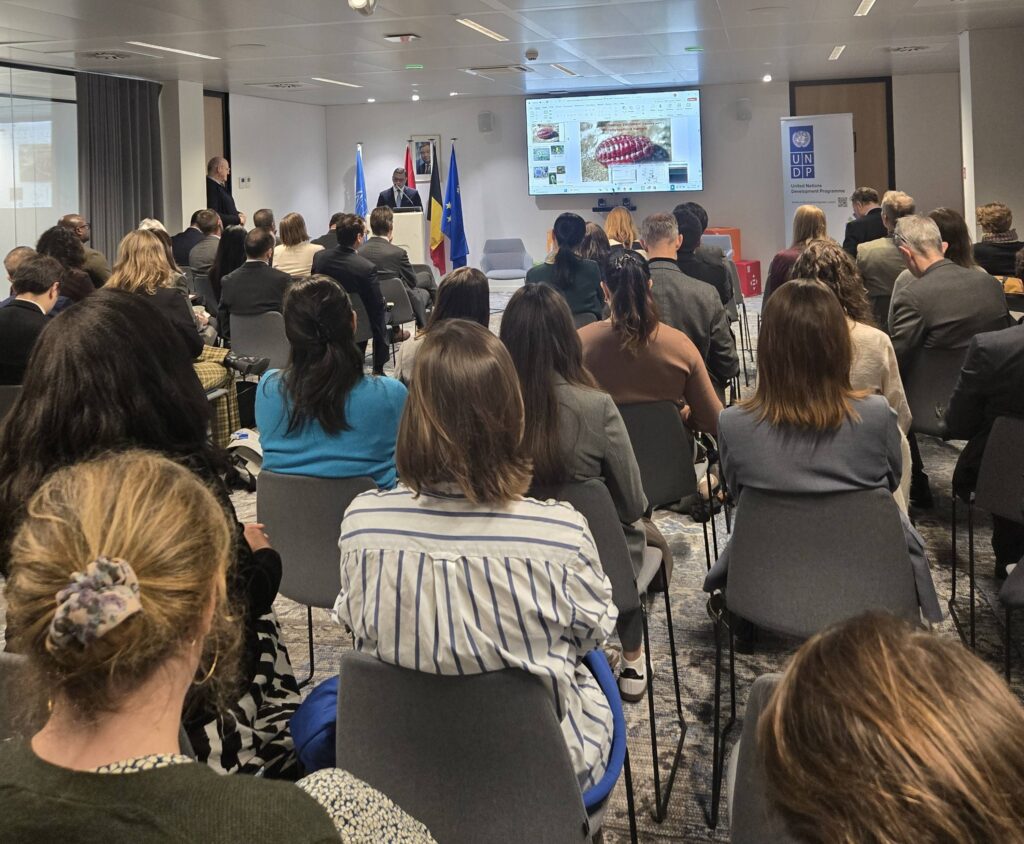
Speaking during the panel “From commitments to action: financing the global biodiversity framework,” our Global Europe Programme Manager Lea Appulo, underscored that wetlands remain largely overlooked in policy and investment, despite being essential for climate stability, biodiversity recovery, and global water and food security.
Speaking of facts, she outlined that wetlands contribute US$39 trillion in annual benefits, supply almost all freshwater, support one billion livelihoods, store 30% of terrestrial carbon, and host 40% of global biodiversity. Yet 70% of wetlands have been lost worldwide, and freshwater biodiversity has declined by 85%. Lea Appulo also emphasised that all 23 targets of the Global Biodiversity framework depend on healthy wetlands and urged decision-makers in the room to close the implementation gap by mobilising more finance for wetland restoration, reducing harmful subsidies, and integrating wetlands into climate and nature finance mechanisms.
We called on the EU to strengthen its external financing framework by embedding in the Global Europe Instrument regulation:
- 50% of funding dedicated to climate and environment, and
- 15% specifically for biodiversity.
A key proposal was the creation of EU Wetland Partnerships, to be embedded within the EU’s Global Gateway, aligning EU investments with the Paris Agreement and the Kunming-Montreal Global Biodiversity Framework (GBF).
These partnerships, a Wetlands International Europe initiative, would enable restoring landscapes, strengthening water governance, mobilising finance, and help countries deliver the Rio Conventions objectives to tackle climate change.
Looking ahead the CBD COP17 in October 2026 in Armenia, COP17 and the first global stocktake of GBF progress, we urged governments, financial institutions and international partners to:
- Adopt EU Wetland Partnerships as a flagship tool to deliver Rio Convention and GBF targets;
- Mobilise finance, political leadership, and technical cooperation for wetland-positive investments;
- Align EU external action with a “wetlands-first” approach, recognising wetlands as essential to climate stability, biodiversity recovery, water security, and development.
Lea Appulo also reaffirmed our strong support for an autonomous LIFE Programme (EU’s financing tool for environment and climate actions), arguing that fragmenting this Fund would undermine decades of EU leadership in environment and climate action.
“Wetlands are the foundation of resilience. Protecting them is essential to securing our shared future,” Lea Appulo said.