
A game to experience the Aquatic Warbler’s migration being tested in France
-
AWOM
-
Biodiversity - Flyways
The implementation of the Aquatic Warblers on the Move project (LIFE AWOM) in migration-affected areas for the Aquatic Warbler is also an opportunity to develop creative ideas to raise awareness on this tiny endangered-bird’ challenges during their journey, especially in schools. Indeed, the migration of trans-Saharan passerines, such as the Aquatic Warbler, is a particularly interesting topic for discussing various issues with young students. In order for these presentations in schools to be both informative and attractive, the LIFE AWOM team recently developed an interactive game; the Great Migration game!
In Late 2025, two French partners of the LIFE AWOM, the Association ACROLA and Bretagne Vivante, already had some ideas in the works about a game representing the Aquatic Warbler’s autumn migration, still in the rough draft stage. The Association ACROLA’s version is mainly digital, whereas the one from Bretagne Vivante is a board game, fully physical. These two versions were promising, but needed to be tested.
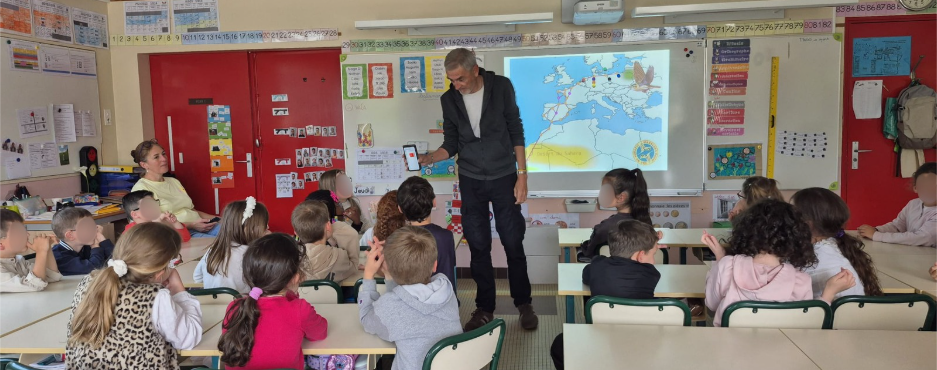
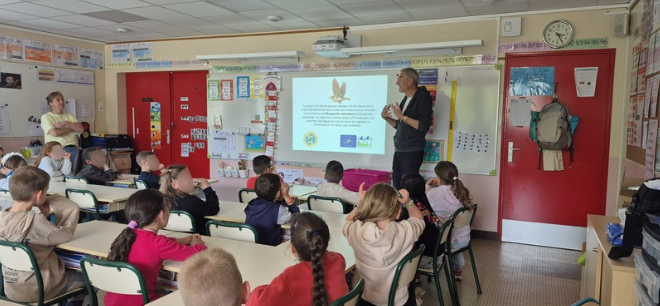
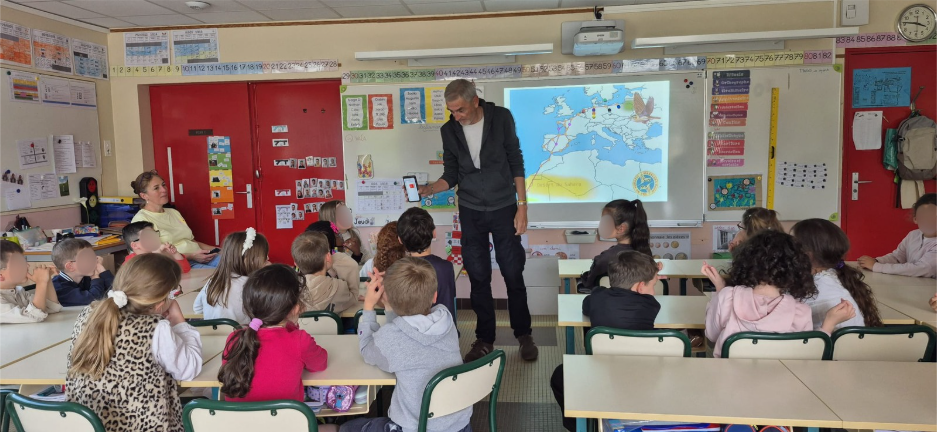
On May 7th 2026, Eugene Archer from the Association ACROLA and Mallaury Lacombe from Bretagne Vivante went to the Pierre & Marie Curie elementary school in Cordemais (near Nantes, western France) with one objective in mind: to present the digital version to the schoolchildren, for them to play and learn about the Aquatic Warbler.
The game board was projected onto the classroom whiteboard. Major stopover sites were represented by squares, each labeled with the minimum number that had to be rolled on the dice to reach it. This number represented the approximate fat level necessary to fly to the next stopover site. The dice was also digital, and coloured magnets represented the birds. Eugene also printed cards representing some positive or negative consequences for the bird, to be drawn if the children rolled a low number on the dice.
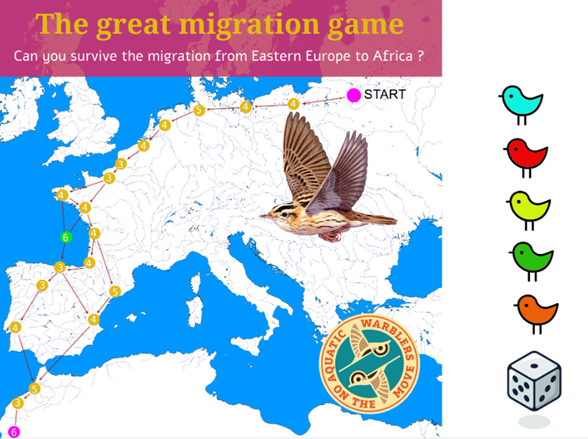
The 25 children were divided into 8 teams of 3-4. They played for almost one hour, with the aim to go from the breeding sites in eastern Europe to the wintering grounds in the Sahel wetlands. Unfortunately, by the end of the session, none of the teams had reached the finish line, with some teams still in Poland at worst, or in southern Spain at best.
Time for feedbacks
Following this test, the students shared their opinions about the game. As it stands, the game is too long and does not seem suitable for such a large number of children. The wait time between turns, caused by the large number of teams, proved to be too long for them, limiting the players’ ability to remember the card drawn previously and its potential effects on the next turn. Also, it seems to be repetitive, and to not engage students enough during a round. Indeed, all they had to do was roll the digital dice… and watch our LIFE AWOM French team moving the magnets or drawing a card and applying its effects depending on the roll of the dice.
This feedback will be helpful to us, as we work to make improvements. The challenge is to develop a game that appeals to children while also reflecting the hardships these little birds face during migration, as they are confronted with ever-increasing threats and pressures. To do so, the number of stopover sites on the game board could be revised downward to save time and allow at least some of the teams to “win” by reaching the wintering grounds. To make the game more engaging for the students, the dice could also be replaced with numbered cards. This would also allow for more strategic play within the teams, as they could hold onto the numbered cards and combine them to move further ahead in the next round. It would also help them practice their maths !
These improvements are currently under consideration, with the aim of having a finalized version by the end of 2026. To this end, we might very well have the chance to test the game again by the end of the school year….