
I’m taking you behind the scenes of a bird ringing station… and it’s no flight of fancy
-
AWOM
-
Biodiversity - Flyways
By Amélie TAGU, Senior communications officer at Wetlands International Europe.
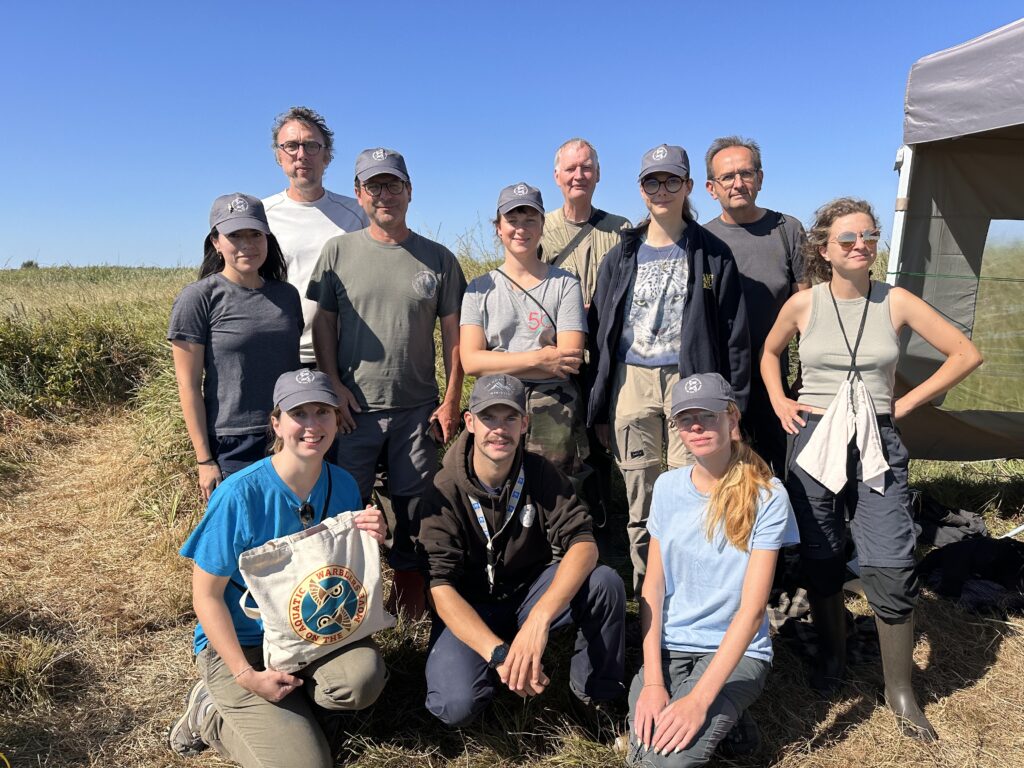
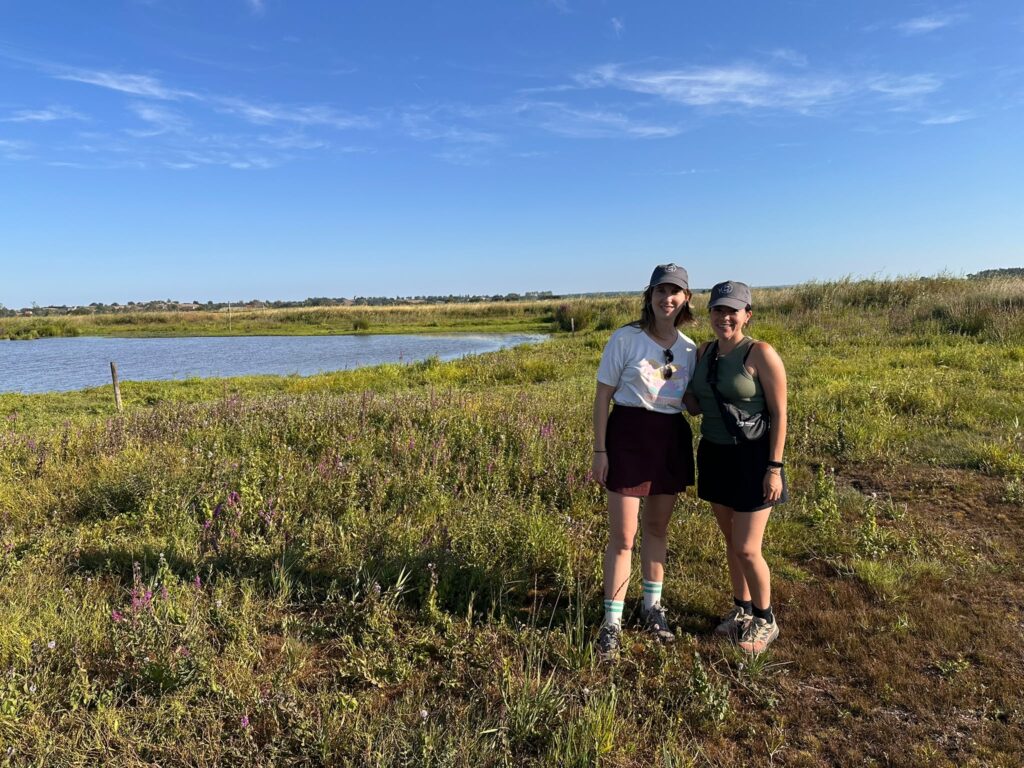
As a city-based communications professional, spending a week at a bird ringing station in the heart of the Normandy marshes was far outside my usual routine. During the week of 10 August 2026, I joined the GONm team – French partner of the LIFE AWOM project – at the Cap ringing station in the Taute Marshes Regional Nature Reserve.
Let me share some of the small moments that never make it into project reports but are at the heart of what makes the LIFE AWOM project so special.
Camaraderie is key
Yes we do have to get up at 5 a.m. to head into the marshes at dawn, yet we still need to sleep, even for a few hours. And because the marshes are located far from the nearest towns, the GONm team usually rents a cottage close to the Cap bird ringing station in the Taute Marshes, for the duration of the ringing season. This is where my colleague Valeria and I first met the ringing team.
In total, a dozen of us are gathered around the table: trainee bird ringers; GONm ornithologists; volunteers; and my colleague and I from Wetlands International Europe immersing ourselves in the LIFE AWOM project field work.
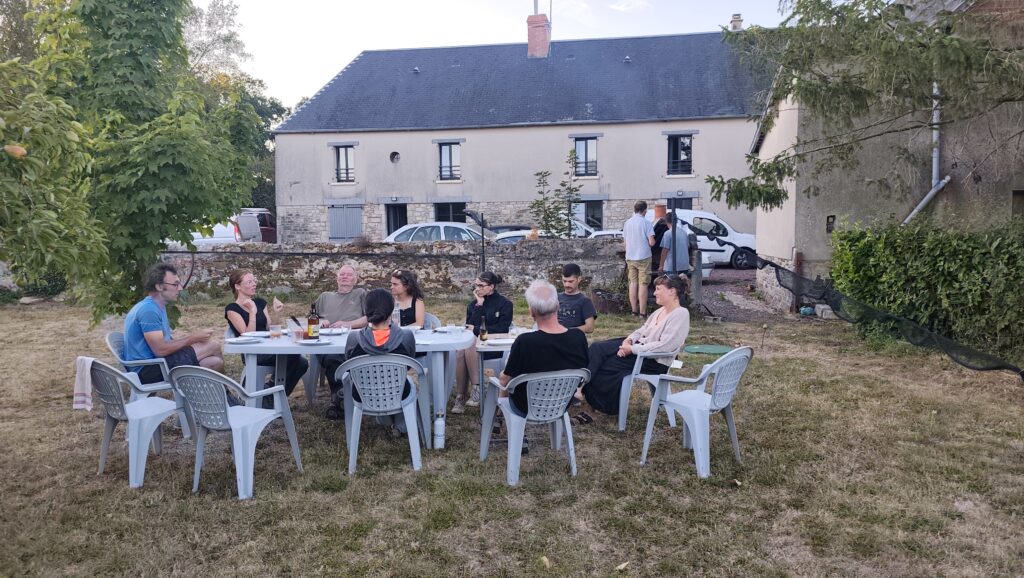
If there’s one thing I quickly learnt, it’s that at a table of naturalists, birds are always at the centre of the conversation. Quite literally. As we shared a friendly meal, puns flew back and forth, and bird-related discussions were never far behind.
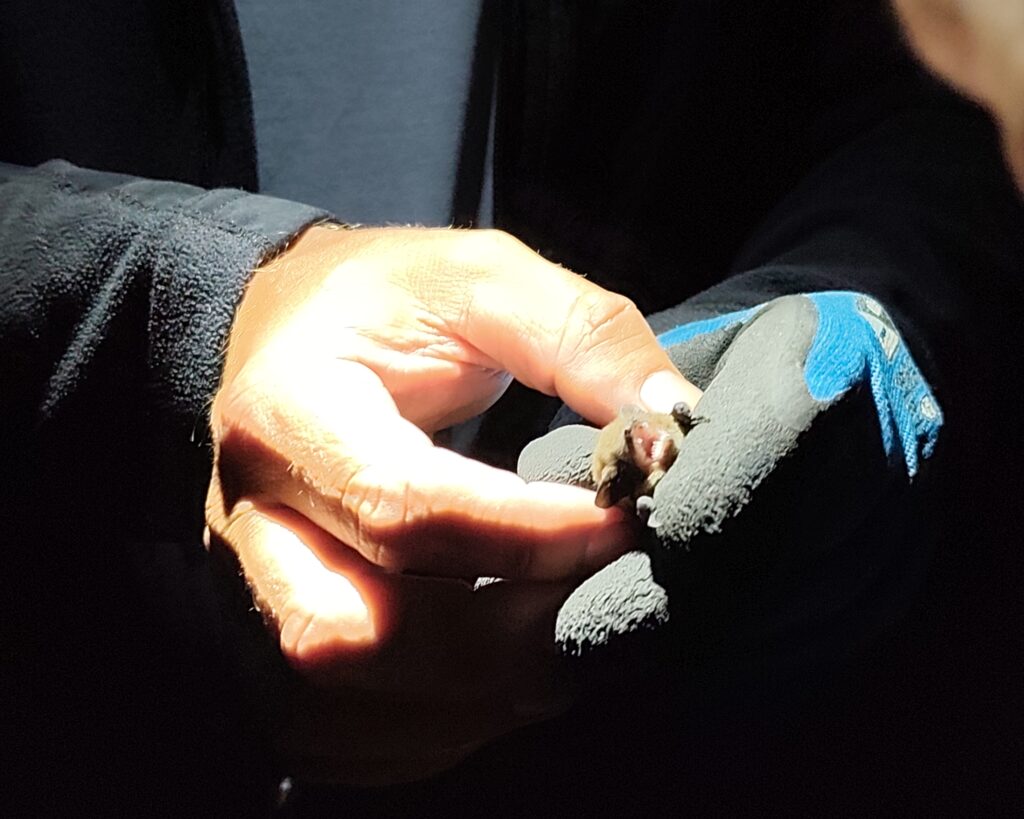
While we ate in the garden, a mist net had been set up behind us to catch bats. James, from the GONm, is a specialist in these fascinating mammals. As soon as night fell, we were treated to a demonstration of the biometric measurements taken from a tiny bat whose species name I sadly failed to remember (sorry, James!). To my surprise, the little creature was absolutely adorable.
But enough chatting. Nets folded away, time for bed. The next morning will begin before sunrise with an early start in the marshes.
Head in the mist
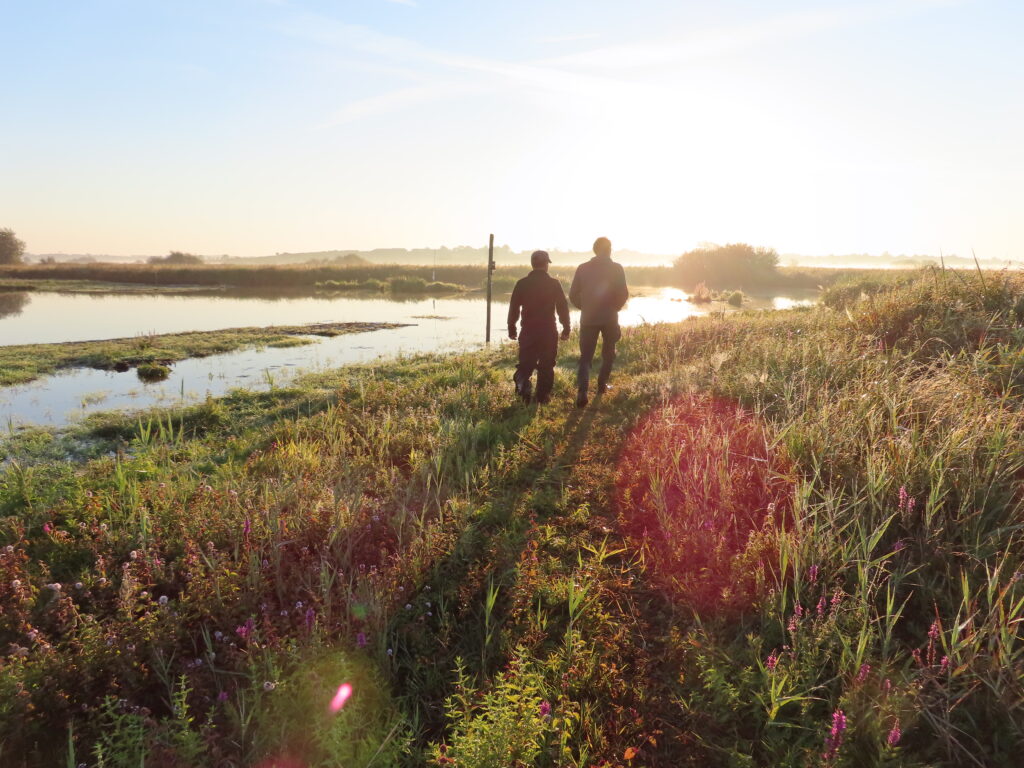
We wake up at 4:45 a.m., still half asleep and quite literally surrounded by fog. Outside, a thick mist hangs over the marshes and the temperature has dropped to 11°C. Damn, I forgot my sweater. Luckily, a kind soul lends me one.
A quick breakfast and we’re off to the marshes, heading for the Cap bird ringing station, about fifteen minutes away by car.
The first thing to do once there is to open the nets. I’m starting to get the hang of the team’s jargon. “I’m taking Net 1. Are you going to Net 4?” In fact, they’re referring to groups of three 12-metre mist nets set up together, according to a highly specific methodology known as the ACROLA protocol.
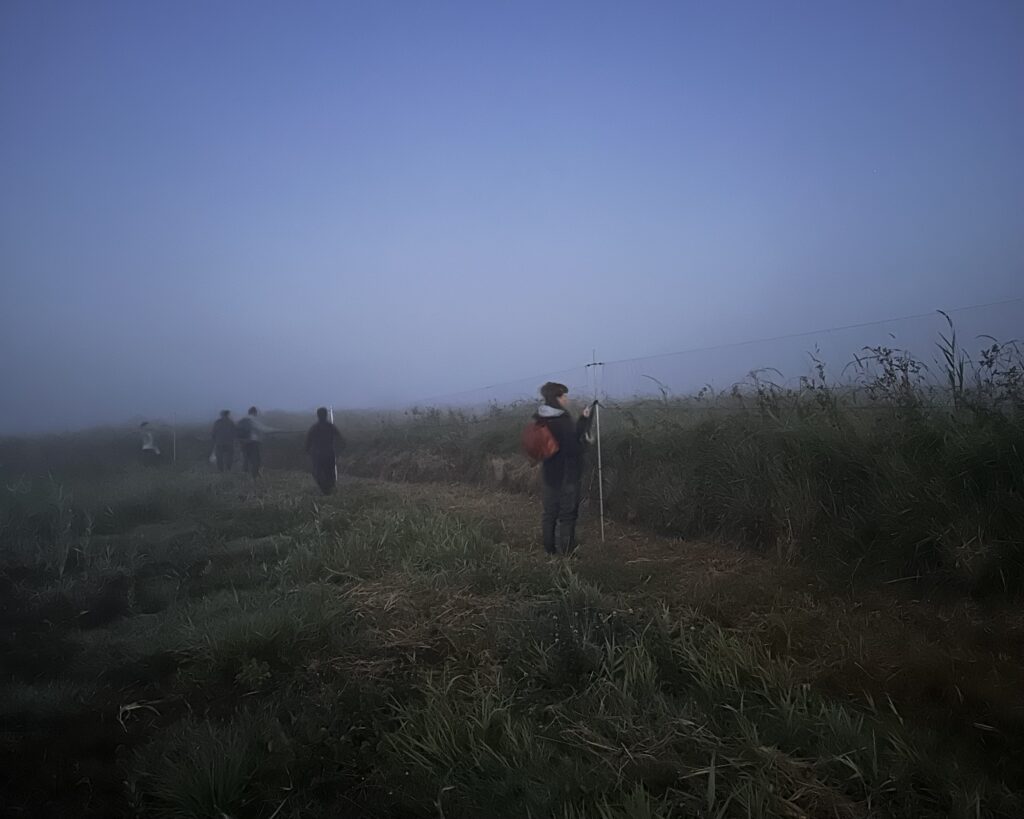
Small speakers are attached to the nets, continuously broadcasting Aquatic Warbler calls. And that’s when I learn something important: back in Brussels, we call it the Aquatic Warbler. Here, everyone simply says ACROLA, a nickname derived from its scientific name ACROcephalus paludicoLA. Much easier, if you ask me.
So there we are, standing in the misty darkness of the marshes, surrounded by bird song playing on a loop. I love the idea that this magical atmosphere may be part of these ornithologists’ daily routine.
Once the nets are open, it’s time for the morning ritual: the predictions. James notes everyone’s guesses for the number of birds and species we’ll catch that day. “It’s a game the Spanish started,” he explains. I joined in despite having absolutely no idea what I was talking about nor what the prize to win was.
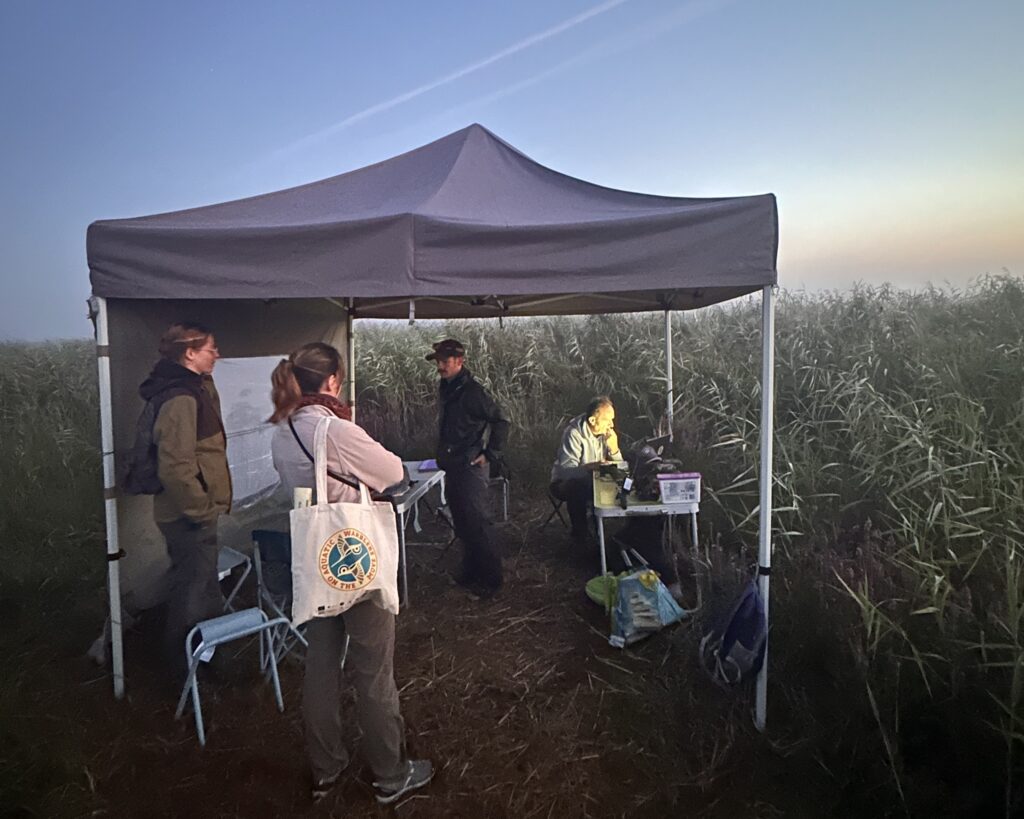
Then we’re off. The bird station is officially open. Every thirty minutes, the team makes “the round”, checking the nets in the hope of finding a few ACROLAs. “You take Net 4, I’ll go to Net 6.” The terminology becomes second nature surprisingly quickly. Alright, I’ll take Net 2. See you in a bit!
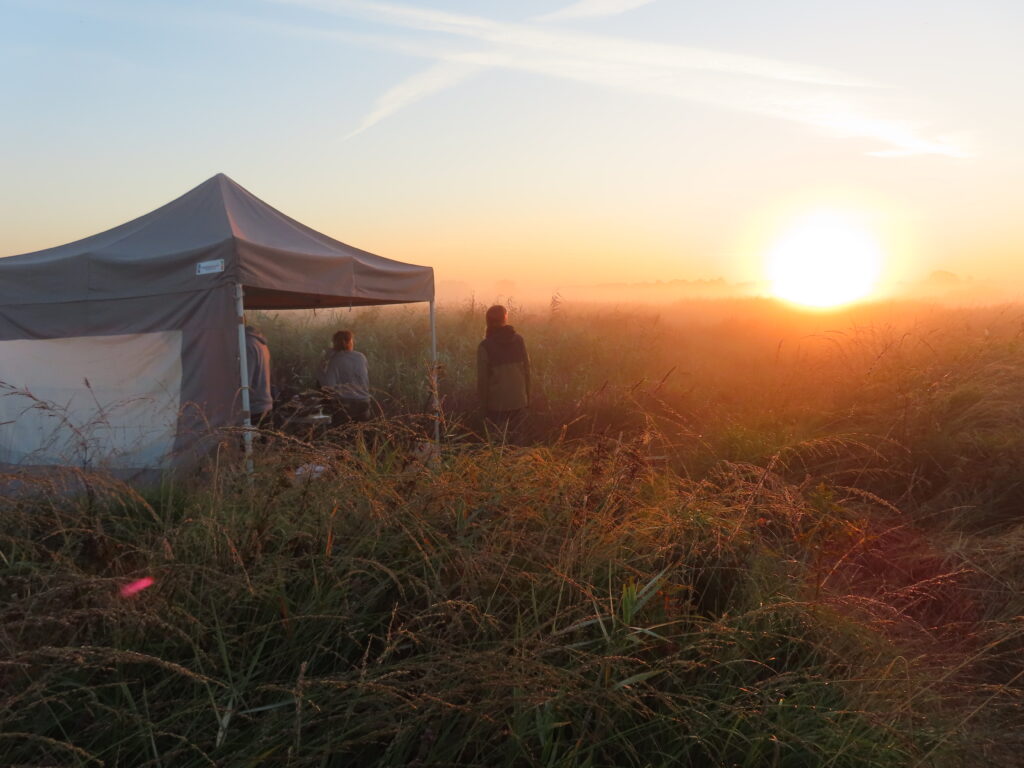
As dawn breaks, the temperature rises. The mist slowly gives way to gentle sunshine, and before long, sweaters are being shed across the marsh.
A place of learning
After each round of net checks, we eagerly watch to see whether our colleagues return with little cotton bags hanging around their necks, the telltale sign that a bird is waiting to be ringed. I later learned that many of these bags are homemade, often sewn by the ringers’ mothers, who share patterns among themselves. A team working behind the scenes.
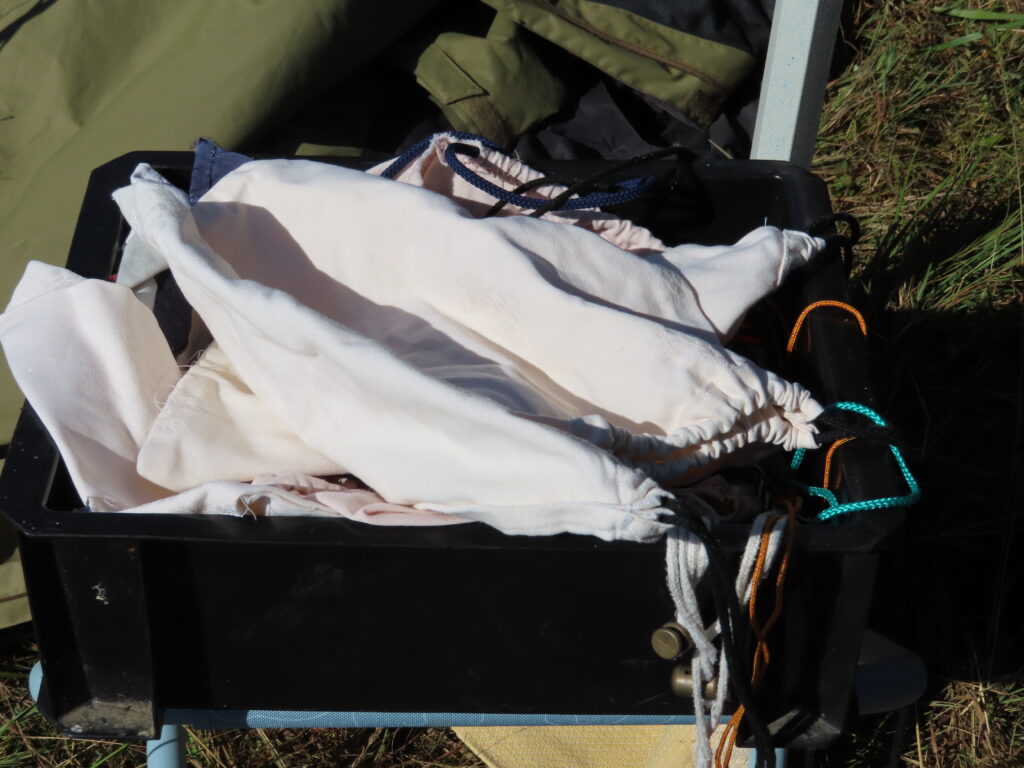
“I prefer to keep the species a surprise,” Dorian tells me as he carefully reaches into one of the bags to retrieve its occupant. This Tuesday, 11 August, turned out to be a particularly quiet day, with very few birds to ring. Bad news for my predictions, but that did not stop me from being fascinated with the ringing process. Laure, the station leader, handles a Sedge Warbler with extraordinary care, taking all the necessary measurements in record time before releasing it as quickly as possible to minimise stress. The goal is simple: less than two minutes to record everything : weight, age, fat score, moult status, and probably a few other measurements I’ve already forgotten.
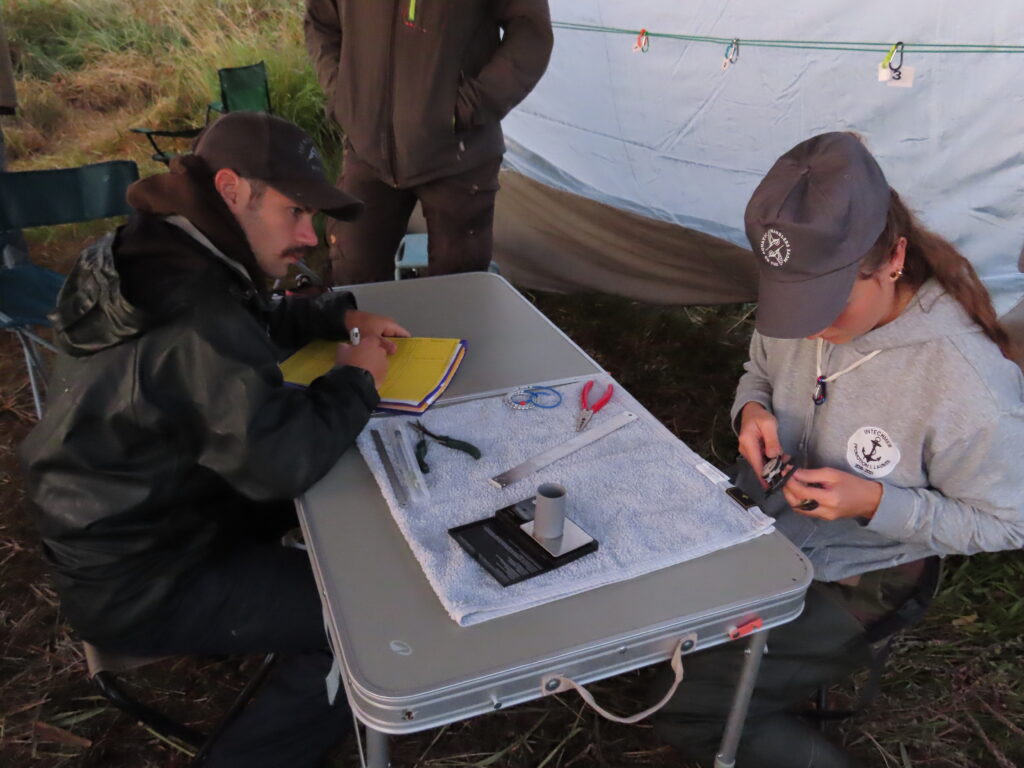
The ringing table is a place of constant learning. Five trainees compare notes, double-check measurements, consult field guides and exchange advice, all with plenty of humour. Around them, the more experienced ringers patiently answer questions and share tips on handling birds quickly and safely.
Dorian explains to me that when the wind picks up, as it had that Tuesday, the nets become more visible to birds as they billow in the gusts. By around 10:30 a.m., as the wind continued to strengthen, the whole team seemed to come to the same conclusion: there would be no more birds to ring that day.
What about women in this field?
Laure is the ringing station leader. In her twenties, she is working towards becoming a qualified bird ringer – a demanding certification process that takes three years and requires a high level of expertise. I am grateful to see a woman at the helm of this predominantly male field, so I strike up a conversation with her.
That is when I learnt that, among the roughly 300 ringers accredited in France, only 15 are women. Fifteen! Laure told me that this imbalance does not particularly bother her as in her view, things are changing. Over the past few years, a new generation has been emerging, one that is far more gender-balanced.
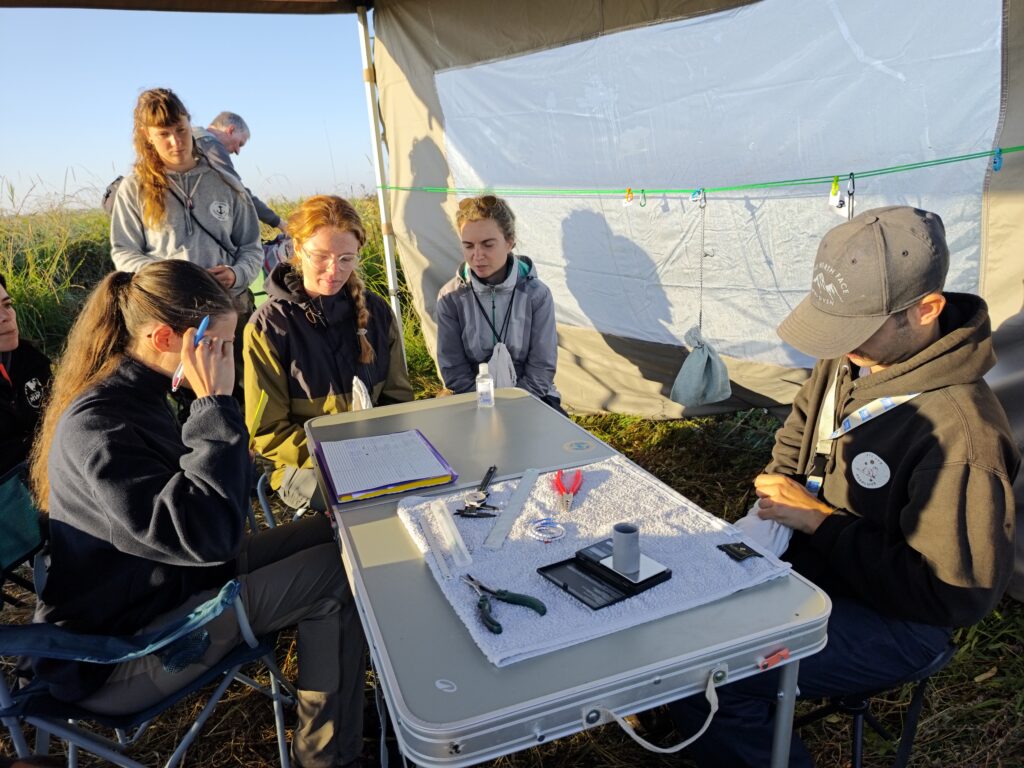
Noa, Marie, Erin, Enola… At the Cap ringing station, I found myself surrounded by young women who have been passionate about ornithology for as long as they can remember and who are determined to turn that passion into a career. The next generation is clearly already here.
To talk birds. Or not to talk. There is no other option
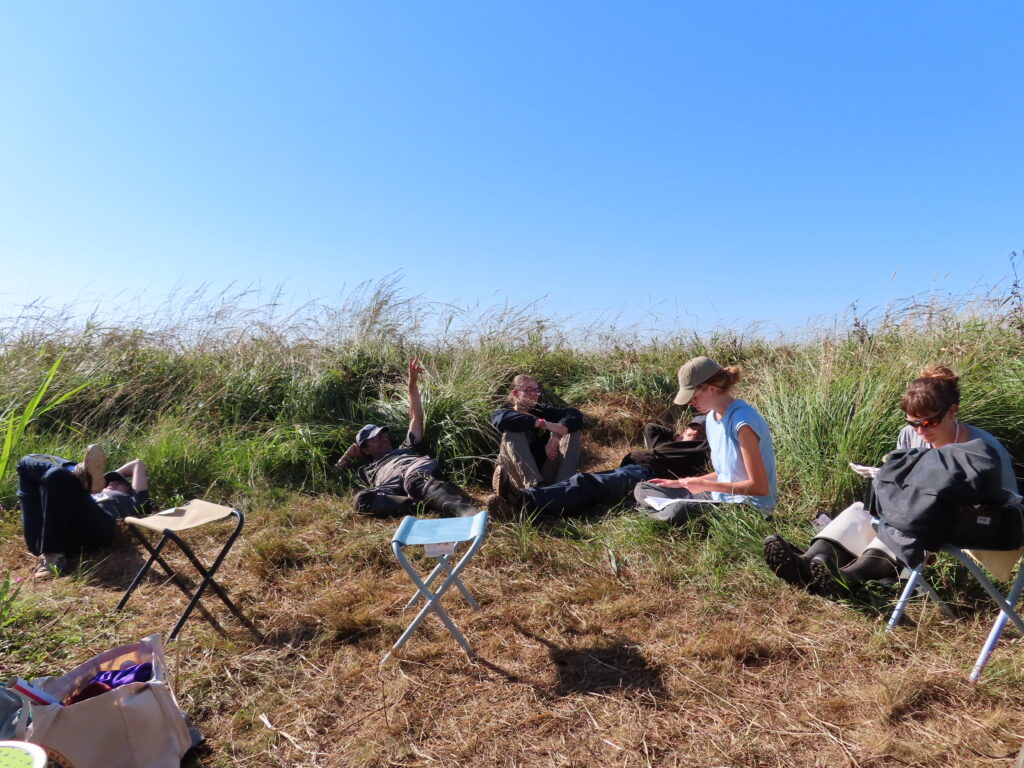
With few birds in the nets, time passed slowly. Some napped, others watched birds through binoculars or scrolled through their phones. Then James launched a game. Great, I thought. I love games! He started quizzing the team: “Laure, tell me: what’s the STOC protocol? Noa, can you name all these ringing tools?” Ah right, these kinds of games… I’ll sit this round out.
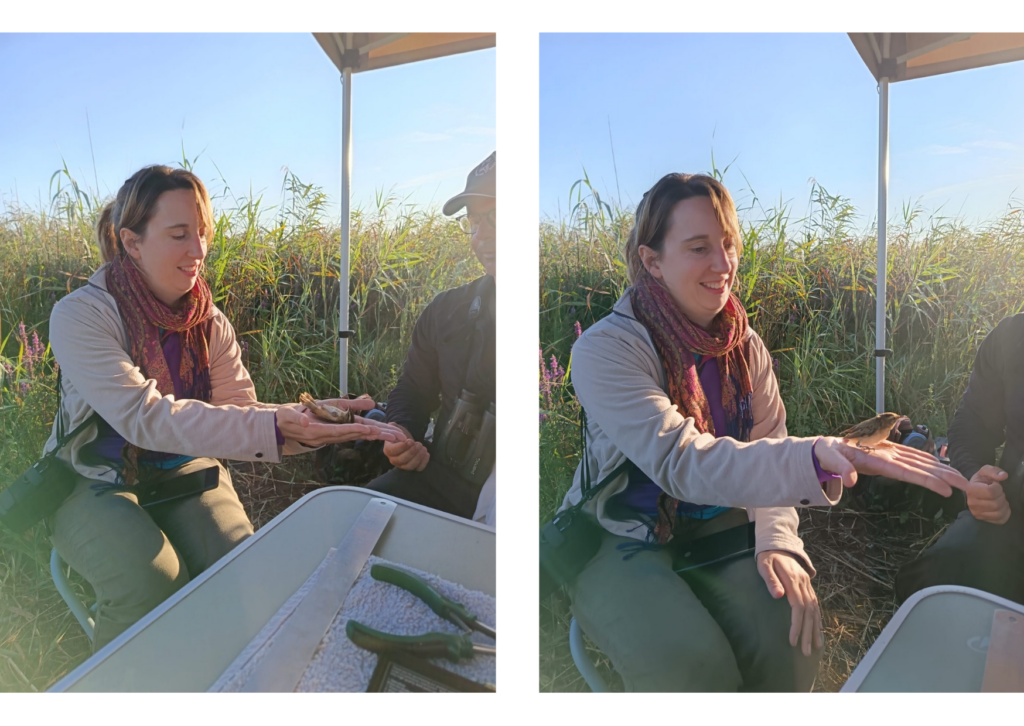
To be fair, James was kind enough to make sure I got my own memorable moment. At the end of one ringing, he gently placed a Sedge Warbler in my hands. What a feeling. It was so tiny, nestled in the palm of my hand. Then I turned my hand over, and in an instant, it took flight!
By noon, ringing operations were over for the day. The nets were folded away, a task that clearly requires a practised hand, and we headed back to the cottage for the afternoon.
The verdict on this Tuesday was mixed: only eleven birds ringed and, much to my disappointment, not a single Aquatic Warbler. A far cry from the “36 birds and 5 species” I confidently bet that morning.
Back at the cottage
As we settle back at the cottage, a small beer quickly brings the fatigue to the surface. My eyes grow heavy, but I enjoy listening to the students chat among themselves. Conversations inevitably return to birds. Favourite species, field stories, identification tips… the topic never seems to run dry.
And that evening, you’ve probably guessed it: more nets go up during dinner. This time, however, we’re not hoping for bats. We’re after swallows. Variety is the spice of life, after all.
I returned home tired, slightly under the weather, and absolutely delighted. Spending a week alongside the GONm team offered a rare glimpse into a world driven by passion, patience, and an extraordinary attention to detail. I am already looking forward to coming back next season to learn more and, with a bit of luck, finally meet an ACROLA up close.
Thank you to the GONm team for taking us under their wing and giving us such a warm welcome!