

Aquatic Warbler: improving knowledge of potential stopover habitats in the Mediterranean
-
AWOM
-
Biodiversity - Flyways
How can we better identify, protect, and manage Mediterranean wetlands that provide stopover sites for the Aquatic Warbler during its spring migration? This is one of the shared objectives of the European LIFE AWOM (Aquatic Warblers on the Move) project and the French National Action Plan (NAP) dedicated to the species.
The Aquatic Warbler, a small migratory passerine considered one of the most threatened birds in continental Europe, depends on a sufficiently extensive and well-connected network of stopover sites to complete its migration cycle. Over five years, the LIFE AWOM project brings together 14 organisations across Europe and Africa to improve knowledge of the species’ migratory routes and habitats, helping to guide conservation actions more effectively.
In France, Tour du Valat contributes to the LIFE AWOM project alongside four other partners, including Bretagne Vivante, which coordinates the National Action Plan for the species.

A day to combine mapping, field observations and strengthen national collaboration
On 8 September 2026, Aquatic Warbler conservation stakeholders from around twenty French organisations, including site managers, scientists and public authorities, gathered – in person and online – in Montpellier. The objective was to combine existing knowledge and prepare the next steps for Aquatic Warbler conservation especially along the Mediterranean coast, which is part of the Aquatic Warbler’s pre-nuptial migration route, every year in Spring.
The session presented two major developments: a map of habitats potentially suitable for the Aquatic Warbler around the Mediterranean Basin, and the first results from spring migration monitoring carried out in 2026.
39 sites mapped, 154,800 ha of natural habitats assessed, and more than 12,500 ha identified as potentially suitable
Conducted by Stéphane Debien, an intern at Tour du Valat, the mapping project aimed to identify habitats likely to be used by the Aquatic Warbler during its spring migration stopovers.
Stéphane Debien conducted this research From March to August 2026 at the ADENA offices in Agde and supervised by a consortium including Bretagne Vivante, ADENA (Bagnas National Nature Reserve) and Tour du Valat.
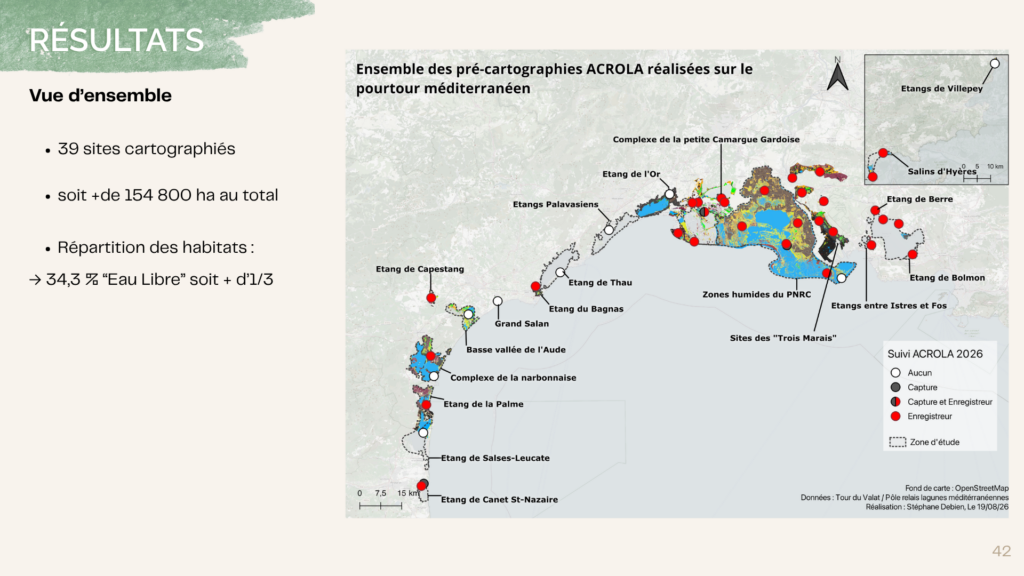
In total, 39 sites were mapped, representing more than 154,800 hectares of natural habitats, over one-third of which consisted of open water habitats. Habitats considered most suitable for the Aquatic Warbler accounted for approximately 12% of the total area, or nearly 12,500 hectares. These results highlight the significant potential of the Mediterranean coastline to support the species during their pre-nuptial migration.
Mapping must be validated in the field
Available datasets vary considerably in age and accuracy: 28% of sites relied on maps produced before 2011, 8% between 2016 and 2019, and 64% after 2020. A survey conducted among site managers helped compare the maps with field realities, and 85% confirmed the ecological relevance of the areas identified as highly suitable.
Local factors like site management practices, grazing or hunting activities, vegetation dynamics, and even the period when mapping was carried out can also strongly influence habitat suitability for the Aquatic Warbler. The next step is therefore to systematically combine mapping with field observations in order to better target future surveys.
Among the main threats identified in Stéphane Debien’s anaysis were the premature drying of wetlands, cited by 61,5% of respondents, and the spread of invasive alien species. On a more positive note, 100% of responding site managers expressed interest in joining an interregional network, creating opportunities for better coordination across the Mediterranean migration corridor.
First results from the 2026 spring migration monitoring
Another highlight of the meeting was the presentation of the first results from the 2026 spring migration monitoring programme. To better understand Aquatic Warbler migration in the Mediterranean region, around thirty acoustic recorders were deployed between 7 April and 10 May 2026 with the support of site managers, bird ringers and financial partners. A total of 32 recorders were distributed to participating sites, each operating for eight hours daily around sunrise and sunset.
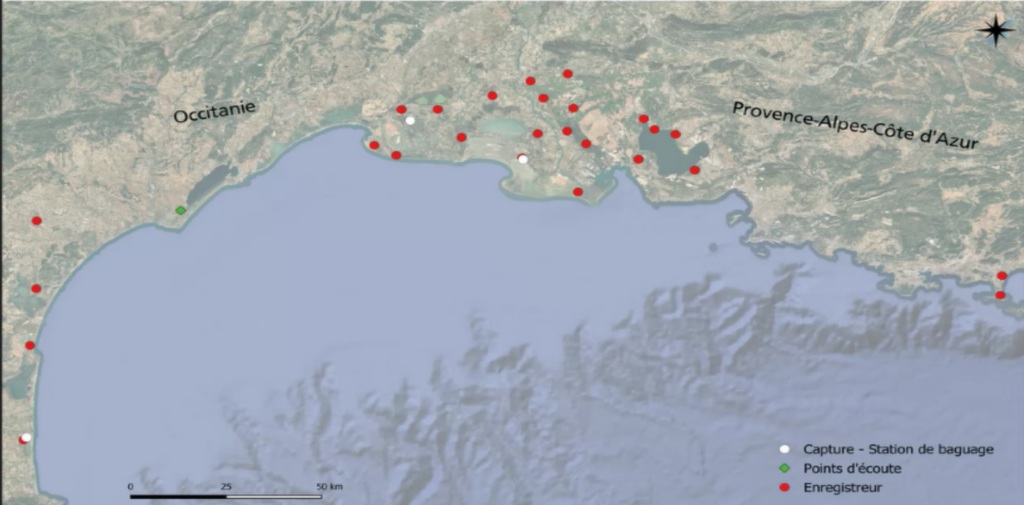
The result was more than 8,000 hours of recordings, which will be analysed using bird song recognition software to detect singing males. A first positive detection has already been obtained at La Franqui, in the municipality of Leucate, using Chirpity.
This approach offers several advantages: it reduces field effort, minimises disturbance to birds during a sensitive period, and can be deployed on sites where ringing is difficult due to grazing or other land uses. The objective for 2027 is to improve the analysis of the recorded data and continue acoustic monitoring throughout spring.
Better knowledge for better protection
The meeting of 8 September confirmed the value of combining habitat mapping, acoustic monitoring, ringing activities and site manager expertise to better understand Aquatic Warbler migration along the Mediterranean coast.
The challenge now is to translate this knowledge into action: identifying key sites, understanding the conditions that favour migratory stopovers, and supporting managers in implementing practices that ensure the long-term conservation of these habitats.
The collective effort established through LIFE AWOM project and the National Action Plan provides a crucial foundation for building a more coherent and resilient network of migratory stopover sites for Aquatic Warblers across the Mediterranean, capable of withstanding future climatic changes.