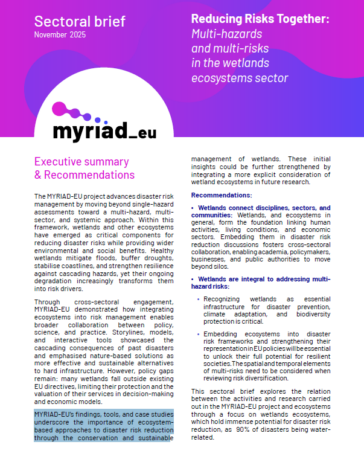

Report on the role of wetlands in disaster risk reduction
For four years, Wetlands International Europe carried the voice of ecosystems and wetlands within the MYRIAD-EU project, which advances disaster risk management by moving beyond single-hazard assessments toward a multi-hazard, multisector, and systemic approach.
In collaboration with MYRIAD-EU project partners, we developed a sectoral brief highlighting the key role wetlands and other ecosystems play within the MYRIAD-EU project and framework, where they have emerged as critical components for reducing disaster risks while providing wider environmental and social benefits. Healthy wetlands mitigate floods, buffer droughts, stabilise coastlines, and strengthen resilience against cascading hazards, yet their ongoing degradation increasingly transforms them into risk drivers.
Through cross-sectoral engagement, MYRIAD-EU demonstrated how integrating ecosystems into risk management enables broader collaboration between policy, science, and practice. Storylines, models, and interactive tools showcased the cascading consequences of past disasters and emphasised nature-based solutions as more effective and sustainable alternatives to grey infrastructure. However, policy gaps remain: many wetlands fall outside existing EU directives, limiting their protection and the valuation of their services in decision-making and economic models.
MYRIAD-EU’s findings, tools, and case studies underscore the importance of ecosystem-based approaches to disaster risk reduction through the conservation and sustainable management of wetlands. These initial insights could be further strengthened by integrating a more explicit consideration of wetland ecosystems in future research.