
MYRIAD-EU’s Scandinavian pilot on wetlands in disaster risk reduction
-
Advocacy
-
Global Europe
Since 2021, Wetlands International Europe has participated in the MYRIAD-EU Project, funded by the Horizon 2020 Programme. The MYRIAD-EU project advances disaster risk management by moving beyond single-hazard assessments toward a multi-hazard, multi-sector, and systemic approach. The peculiar role wetlands can play in such a project on disaster risk assessment and management was notably explored in the project’s Scandinavian pilot study, led by CICERO.
A first article on the topic, presenting wetlands as game-changers for climate change mitigation and adaptation, was published in 2023, exploring the role of ecosystems in climate change adaptation (CCA) and disaster risk reduction (DRR) and highlighting the potential of nature-based solutions (NbS) to reduce the severity of multi-hazard events.
With the MYRIAD-EU project concluding in December 2025, we reflect on key achievements and takeaways from the past four years. We asked Anne Sophie Daloz and Lin Ma, the leaders of the Scandinavian pilot, a few questions on their experience working with wetlands in the context of the MYRIAD-EU project.
1. Why consider and include wetlands, and in particular peatlands, in the Scandinavian pilot?
Working on and with wetlands bridges climate risks and climate adaptation. It allows us to think of solutions yielding multiple benefits, not only related to DRR, but also to wider and numerous ecosystem services provided by healthy wetlands for human health and well-being, for species conservation or water-cycle regulation, to name only a few. Furthermore, the Scandinavian pilot benefited from an enabling policy framework, especially related to a precious type of wetland ecosystem : peatlands. Norway launched in 2016 a National Plan for Peatland Restoration (see Kyrkjeeide, Magni Olsen et al. 2024), shining light on peatlands and their role as an important NbS for DRR, thus attracting interest from authorities, stakeholders and researchers.
2. What has this approach brought to you? What would you identify as your main takeaways from working on and with wetlands NbS in the Scandinavian pilot?
Wetlands, and in particular peatlands in the case of the Scandinavian pilot, can address multiple hazards and enhance resilience in the face of flood peaks, droughts, wildfires or water pollution (Bertassello, L.E. et al. 2025). It thus made sense to consider them in the MYRIAD-EU project to bridge multi-hazard and multi-sector aspects, as in the long run, conserving and restoring wetlands may reduce multiple systematic risks like floods and wildfires, on top of their carbon sequestration capacity.
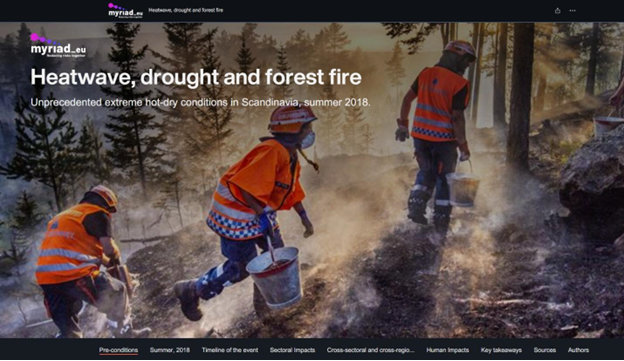
As Norway is getting warmer and wetter, we expect more extreme precipitation and floods in the future, and are starting to notice these changes (e.g. Hans 2023, Jakob 2024), while also seeing emerging combinations of more unusual hazards for the region, such as heatwaves and droughts (see Scandinavian Pilot Storyline on summer 2018 hot-dry conditions).
Wetlands allow us to think about climate adaptation or solutions to several hazards or combinations of hazards at the same time (e.g. heatwaves and droughts, extreme precipitation and floods).
Figure 1 – ‘Heatwave, drought and forest fire’ : Scandinavian Pilot Storyline on summer 2018 hot-dry conditions.
Moreover, wetlands, including peatlands, bring numerous co-benefits: these powerful carbon sinks bridge climate adaptation and mitigation efforts, when well-conserved and healthy, while supporting biodiversity conservation and ecosystem restoration initiatives.
Finally, thinking around wetlands, includingpeatlands, commands to collaborate with a variety of actors, to involve local authorities and stakeholders to design disaster-risk reduction pathways which integrate cross-sectoral economic impacts (related to peatland forestry and agriculture, for example) and account for ecosystemic impacts and social acceptance. As wetland ecosystems can span across large landscapes, local governments need to coordinate dialogue at different levels and stakeholders to design the pathways.
3. Based on your experience, what would you recommend to other researchers and practitioners in exploring similar approaches?
We would recommend the following to researchers and practitioners:
- To strengthen their understanding of the links between climate and nature, and to integrate NbS more effectively into climate adaptation and disaster risk management.
- Instead of taking the perspective of single hazards, think about hazards in combinations (multi-hazards) from the start, and integrating different timelines in terms of impacts (e.g. 2018 – heatwaves, droughts and wildfires had instantaneous impacts while the associated bark beetle outbreaks affected the Norwegian forests in 2019).
- To expand horizons and explore various quantitative and qualitative methods. Methods developed and explored throughout the MYRIAD-EU project. Qualitative methods such as DAPP-MR or storylines, as well as quantitative ones such as the GRACE economic model, which considers both cross-sector and cross-regional aspects, have proven to be good tools to embark on a multi-hazard, cross-sectoral, disaster risk assessment and management adventure.
4. Finally, is there a particular message you’d like to share to conclude?
The final year of the MYRIAD-EU project began after the publication of the landmark Assessment Report on the Interlinkages Among Biodiversity, Water, Food and Health (known as the Nexus Report) by the Intergovernmental Platform on Biodiversity and Ecosystem Services (IPBES) in December 2025. The challenges explored in this report, projecting interactions between three or more of the nexus elements, highlight that business as usual cannot prevail anymore, as it would result in adverse outcomes for biodiversity, water quality or human health. Similarly, focusing on the improvement of only one part of the nexus can negatively impact other nexus elements. Such observations, although relatively new in the global environmental policy landscape, remind in many aspects of the approach adopted within the MYRIAD-EU project.
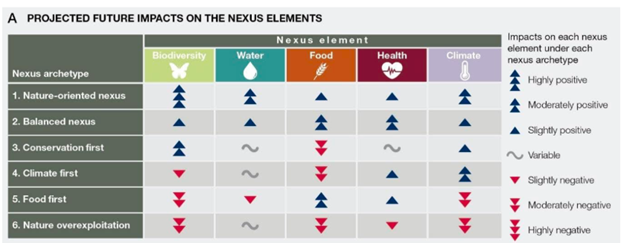
Figure 2. Table on projected future impacts on the nexus elements from the IPBES Assessment Report on the Interlinkages Among Biodiversity, Water, Food, and Health
Both IPBES and MYRIAD-EU highlight the urgent need to prepare for future scenarios through appropriate response options. Both the nexus report and work from the MYRIAD-EU project put forward the protection and restoration of carbon-rich ecosystems, such as wetlands (e.g. peatlands) contribute to synergistically managing nexus elements and yield positive impacts across the nexus.
After four years, we can confidently confirm the message that emerged from working on wetlands in the Scandinavian pilot, and push it forward in hope for a better, greener and safer future: restoring, conserving and wisely managing wetlands can reduce multi-hazard risk across different sectors.