
New report out: how EU policy could fast-track nature-based solutions in the Netherlands
-
Advocacy
-
Nature based solutions
-
Freshwaters
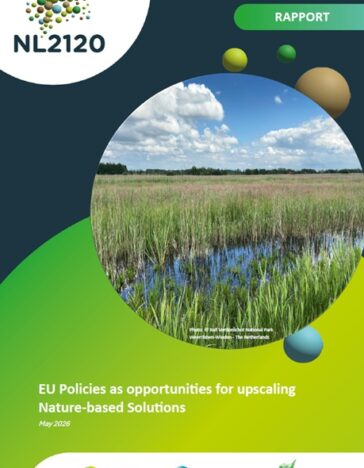
We just co-signed a new report with the IUCN Netherlands, assessing the current EU legal landscape with regards to allow more nature-based solutions in the Netherlands. This publication was produced as part of NL2120, a knowledge and innovation program funded by the Dutch National Growth Fund in which academia, the business community, government, conservation organisations, and the education sector collaborate on a climate-resilient and nature-based approach to the Netherlands by scaling up nature-based solutions.
Download the report
Downloads
Interview with Claire Mc Camphill, our nature-based solutions expert and co-author of the report
Claire McCamphill, our nature-based solutions senior officer, is the lead author of the report “EU Policies as opportunities for upscaling Nature-based Solutions” , recently published under the NL2120 programme. Together with Antoinette Sprenger of IUCN NL, she presents a careful and pragmatic argument: the Netherlands has already been legally obliged multiple times to deliver results that nature-based solutions (NbS) can help achieve. Drainage, dikes, and dredging do not bring the country to where European legislation requires it to be by 2030. Working on the restoration of water, soil, and ecosystems does.
A long-standing problem
For three decades, the Netherlands has built up a tangle of obligations under EU law: the Water Framework Directive, the Flood Risk Directive, the Birds and Habitats Directives, the Marine Strategy Framework Directive, the Common Agricultural Policy, and more recently the European Climate Law and the Nature Restoration Regulation. Each requires national plans, measurable results, and periodic reporting to the European Commission.
In policy terms, the Netherlands has consistently treated these obligations as costs to be minimised. River basin management plans focus on solving problems at the end of the chain. The Common Agricultural Policy still largely supports drainage and irrigation-based agriculture, more so than water retention. Nitrogen policy has moved from crisis to crisis in recent years. The Commission’s own implementation reports repeatedly note that the Netherlands is failing to meet the targets of the Water Framework Directive, that protected habitats are in poor condition, and that progress on the Flood Risk Directive has stalled in areas outside the major rivers.
At the same time, the underlying conditions are shifting. More severe flooding, longer droughts, soil salinisation, declining biodiversity, and a nitrogen ruling that has rendered many planning decisions unlawful. The infrastructure-first model is running up against ecological, financial, and legal limits, all simultaneously.
What the report aims to achieve
The report has a deliberately practical purpose. Claire McCamphill, who worked at the European Commission for eleven years with precisely these guidelines, mapped out every major EU plan (at the interface of land and water) that the Netherlands must adopt or revise over the next three years. For each plan, she identified where the country is lagging behind in meeting its legal obligations, and where NbS can plausibly close that gap.
Six policy moments stand out: the National Recovery Plan, expected in 2026; the next plans for the Common Agricultural Policy, which are to be adopted by the end of 2027 (as part of the newly proposed structure of National and Regional Partnership Plans); the River Basin Management Plans and Flood Risk Management Plans in 2028; the revised Drinking Water Directive; the updated Marine Strategy; and the National Energy and Climate Plan for land use. Each plan has its own planning cycle, a responsible ministry, and a specific moment when officials should be open to evidence and ideas.
Nowhere in existing legislation does it state that you must use NbS, explains McCamphill. But there are possibilities in the way this legislation can be interpreted to truly mainstream NbS. Drafting these plans is the moment when that happens.
The report combines this Dutch analysis with seven case studies from the rest of Europe: the Danish tripartite agreement on agriculture, which can serve as a blueprint for the Netherlands to emerge from its ongoing nitrogen and nature crises; the German Blue Belt programme for waterways, which demonstrates good practices for intergovernmental cooperation on shipping issues; the Scottish law requiring authorities to first consider natural flood management; the Copenhagen cloudburst plan for urban NbS; and the British Biodiversity Net Gain scheme, which makes nature restoration a mandatory part of spatial planning legislation. These best practices were selected for their relevance to the Dutch context and offer ideas for how NbS can be further advanced.
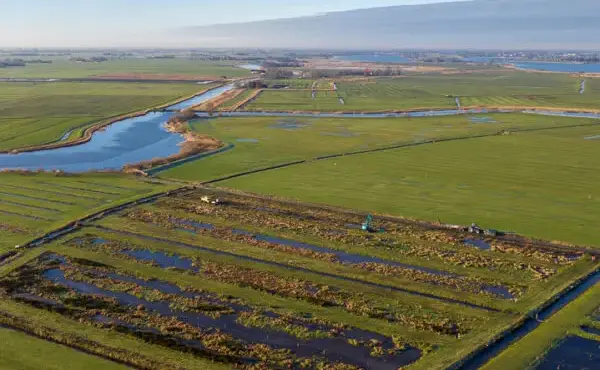
 Image: Herman Agricola
What hinders progress
Both authors are frank about the obstacles. One major obstacle is governance regarding interconnected issues: NbS impact multiple domains, but decision-making is distributed across ministries. “Each ministry makes decisions within its own domain, despite the fact that the issues are inextricably linked,” says McCamphill. NbS offer answers to many challenges, but only if, for example, the water sector has some possibility of having water retention measures incorporated into and financed within the agricultural sector (for example, through the plans for the Common Agricultural Policy). A unifying landscape vision for the Netherlands, which can subsequently be developed by the ministries involved within all the various plans regarding water, agriculture, and nature, could be of great value. Denmark can serve as a source of inspiration in this regard.
The second obstacle is political. Sprenger points to the changing Dutch cabinets, the scrapping of the farmers’ buyout fund under political pressure, and the financial vulnerability of many farmers due to loans tied to intensive production models. “There must be political will, as Claire already said, to face reality and not come up with short-term solutions, she says. It might be useful to enter into dialogue with the architects of the tripartite agreement in Denmark, to understand how it came about and which lessons are applicable to the Dutch context.”
The third obstacle lies at the EU level. McCamphill is open about this: “There is much less willingness in this Commission to force Member States to do something they do not want to do.” The agenda regarding competitiveness and defense has pushed environment and climate further back on the political agenda. The next EU budget – the proposed Multiannual Financial Framework – for example, scraps earmarked funding for agri-environmental measures and leaves allocation to individual Member States. Countries wishing to allocate a large budget for nature conservation within agricultural plans can do so; countries that do not view this as a priority do not have to. It is unclear where the current Dutch government stands on this point, but the draft plans for nature restoration are remarkably silent regarding budget.
The fourth obstacle is harder to measure, but carries significant weight: there is still too little quantified, transferable evidence with which a Minister of Finance or a Board of Directors can put a concrete figure on what NbS yield. Data at the location level does exist; the economic substantiation at the portfolio level is still weak.
A vision worth defending
For McCamphill and Sprenger, the way forward involves various practical steps. Influence the National Recovery Plan and the National Water Programme now, while they are still being drafted. Insist on quantified water retention or “sponge” targets in the new EU climate adaptation legislation, expected at the end of 2026. Use the Common Agricultural Policy plans to actually pay farmers to retain water on the land, rather than draining it away.
They also view a different framing as essential. Nature conservation structures should not be presented as a green perk, but as critical infrastructure that must be planned for. It underpins economic resilience and limits escalating climate risks. “If you can address flood and drought effects through preventive measures rather than combating the consequences after the fact, says McCamphill, that might become an argument that politicians do want to hear, focused on competitiveness.”
Sprenger adds another element: the “Dutch Diamond” model, in which government, business, science, and civil society share the same agenda. No single party can bring about this transition alone, and the experience with the Danish tripartite agreement—a deal between the government, farmers, and environmental organizations that survived a change of cabinet—shows what that looks like in practice.
The Commission’s recent call to gather evidence on climate resilience concluded that NbS should be Europe’s “first line of defence”. The challenge, McCamphill notes, is to ensure that that conclusion survives the journey from a report to binding legislation, and from there to the next planning cycle of a Dutch ministry. That is precisely the journey this report is intended to help with.